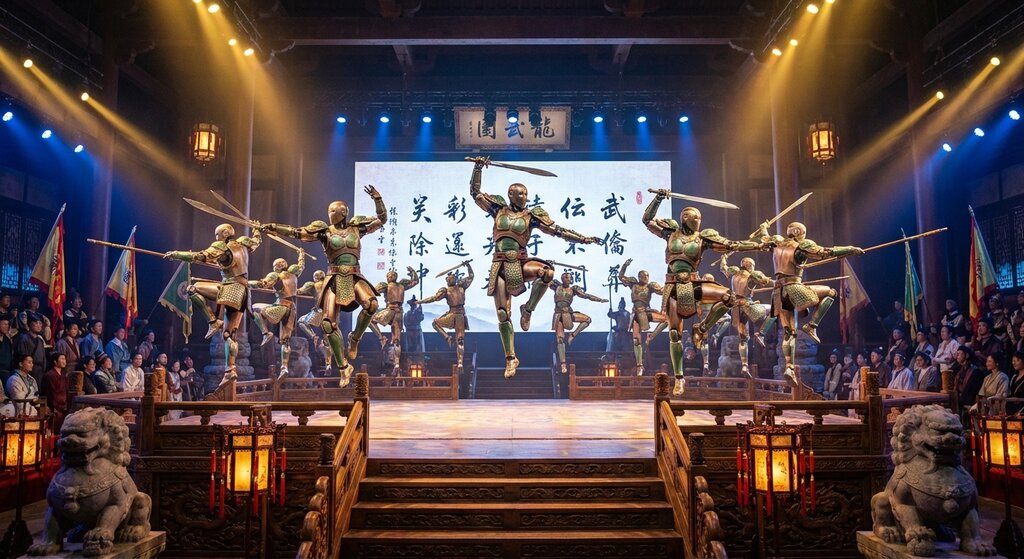
Unitree's Humanoid Robots Just Performed Kung Fu on China's Biggest Stage
If you think humanoid robots are still stumbling around labs, China just corrected that assumption on live television.
On February 16th, Unitree Robotics brought dozens of its G1 humanoid robots to the CCTV Spring Festival Gala — China's most-watched annual broadcast, often compared to the Super Bowl but with an audience north of a billion viewers. The robots didn't just walk on stage. They performed synchronized Kung Fu.
WuBOT Takes the Stage
The performance, called "WuBOT" (武 BOT), featured Unitree's G1 robots alongside students from the Henan Tagou Martial Arts School. The robots wielded swords, poles, and nunchucks. They executed spinning strikes, drunken boxing wobble-and-recovery sequences, and even launched off trampolines for backflips. All fully autonomous. All tightly synchronized.
This wasn't Unitree's first gala appearance — they've been an official partner for three consecutive years. But the leap from last year is staggering. In 2025, sixteen robots waved handkerchiefs in unison. In 2026, they're sparring with weapons alongside human martial artists.
At a sub-venue in Yiwu, Unitree's taller H2 humanoid appeared dressed as the Monkey King — China's beloved mythological trickster — riding a "somersault cloud" built from B2W quadruped robots. Four humanoid companies total got airtime across the gala: Unitree, Galbot, Noetix, and MagicLab. But Unitree's contributions stood head and shoulders above the rest.
The Numbers Behind the Spectacle
China now produces roughly 90 percent of the world's humanoid robots. Around 13,000 units shipped globally last year, and analysts project that number will climb past 28,000 in 2026. The G1 itself — 130cm tall, 35kg, with 23 degrees of freedom — retails for around $13,500. That's not a research prototype price. That's a product price.
Beijing-based tech analyst Poe Zhao put it plainly: "Humanoids bundle a lot of China's strengths into one narrative — AI capability, hardware supply chain, and manufacturing ambition." President Xi Jinping has personally met with robotics founders in recent months, and gala appearances have historically translated into contracts, capital, and accelerated adoption.
Why This Matters for the Robotics Industry
A robot that can execute a spinning strike, recover from a shove, and coordinate with dozens of peers on stage carries capabilities that extend far beyond entertainment. Balance recovery, real-time motion planning, multi-agent coordination, and dynamic object manipulation — these are the exact same skills needed in warehouses, manufacturing floors, elder care facilities, and homes.
The gap between "impressive demo" and "useful deployment" is closing faster than most people realize. And the companies solving that last mile — the operational infrastructure to actually get robots into the field, maintained, and running — are going to be critical as these machines move from stages to living rooms.
Unitree and peers like AgiBot are already signaling mass production plans and potential public listings. The humanoid robot industry isn't coming. It's performing Kung Fu on prime-time television for a billion people.
The only question left: who's building the infrastructure to deploy them?