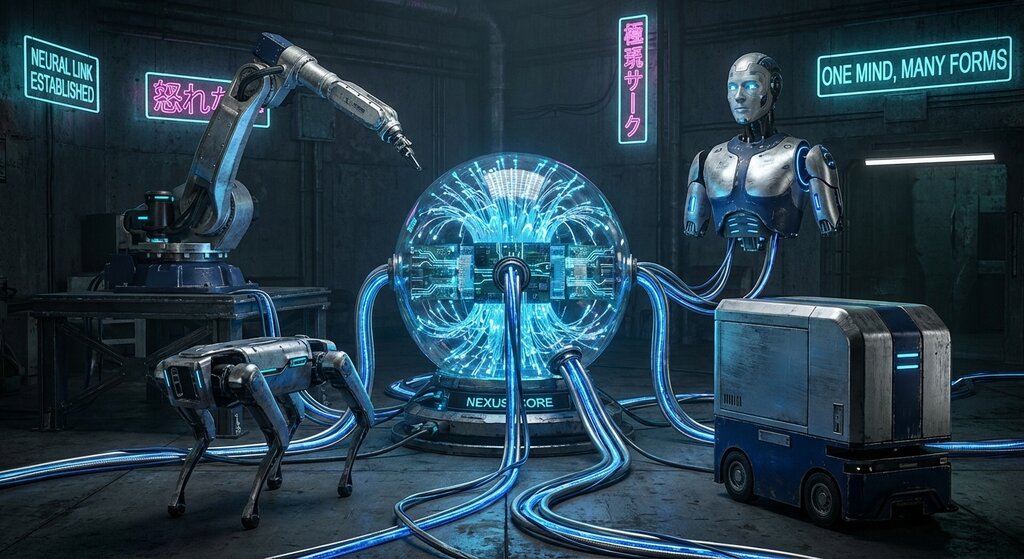
Skild AI's $1.4B Bet: Why the Robot Brain Is Becoming More Valuable Than the Body
Skild AI's $1.4B Bet: Why the Robot Brain Is Becoming More Valuable Than the Body
The robotics industry just witnessed its most consequential funding round yet.
Skild AI raised $1.4 billion at a valuation exceeding $14 billion—more than tripling its value in just seven months. SoftBank led the round. Nvidia and Jeff Bezos joined. Sequoia and Lightspeed doubled down.
The message from the market is unmistakable: we're betting on brains, not bodies.
The Skild Brain: One AI, Any Robot
Founded in 2023 by former CMU professor and Meta AI researcher Deepak Pathak, Skild AI isn't building humanoid hardware. It's building what they're calling the "Skild Brain"—a foundation model designed to control virtually any robot, regardless of form factor.
The same AI brain that navigates a warehouse AMR can reportedly pilot a humanoid, manipulate an industrial arm, or coordinate a fleet. The robot body becomes commodity. The intelligence layer becomes the platform.
This isn't an incremental improvement. It's a structural shift in how the industry thinks about value capture.
What This Means for Robot Manufacturers
At Robot Rental Company, we've always believed that robot manufacturers are partners, not competitors. The hardware-makers—1X, Unitree, Boston Dynamics, Apptronik—are solving brutally hard engineering problems. They're building platforms that will change how work gets done.
But Skild AI's raise validates something bigger: the intelligence layer may capture more value than the mechanical layer.
Think about computers. Intel and AMD make essential chips. But Microsoft, Google, and OpenAI capture the majority of value in the ecosystem. The operating system matters more than the processor.
Skild AI is betting that robotics follows the same playbook.
The Infrastructure Implications
For operators like us, this trend is double-edged.
Upside: A universal robot brain means we could theoretically deploy any hardware with the same AI backend. Fleet heterogeneity becomes manageable. Training costs plummet. Robots get smarter faster through shared learning.
Challenge: If intelligence consolidates to a few foundation model providers, hardware margins get squeezed. Manufacturers become undifferentiated unless they build their own AI moats—or partner exclusively.
We've already seen this dynamic play out. Tesla builds its own AI stack. 1X is developing world models. Figure has Helix. The smart manufacturers are vertically integrating precisely because they're reading the same tea leaves Skild AI's investors are.
The $14B Question: Can It Work?
Foundation models worked for language because text is a unified format. Robotics is different. Every robot body has different kinematics, sensors, and physical constraints. A policy that works on a Unitree G1 might fail catastrophically on a Digit.
Skild AI claims their model generalizes across embodiments. They've raised over $2 billion total to prove it. The compute requirements alone are staggering—SoftBank and Nvidia aren't passive investors; they're providing the infrastructure this bet requires.
If it works, Skild AI becomes the Android of robotics. If it doesn't, they become a cautionary tale about applying LLM logic to physical systems.
Why This Matters for You
Whether you're a manufacturer, an operator, or someone waiting for a robot that can actually load a dishwasher, this funding round is significant.
It signals that capital believes robotics has reached platform-scale. Not just gadgets. Not just demos. A genuine compute layer that can absorb billions in investment and generate returns.
The industry is graduating from "will robots work?" to "who controls the intelligence that makes them work?"
At Robot Rental Company, we're watching closely. Because whoever wins the brain wars will need infrastructure partners—the logistics layer that gets robots deployed, maintained, and recovered.
That's a bet we're happy to make.