Robots Building Robots: Unitree Deploys G1 Humanoids in Its Own Factory
There's a moment in every emerging technology's lifecycle when the recursive loop closes — when the thing starts making more of itself. For humanoid robotics, that moment just arrived.
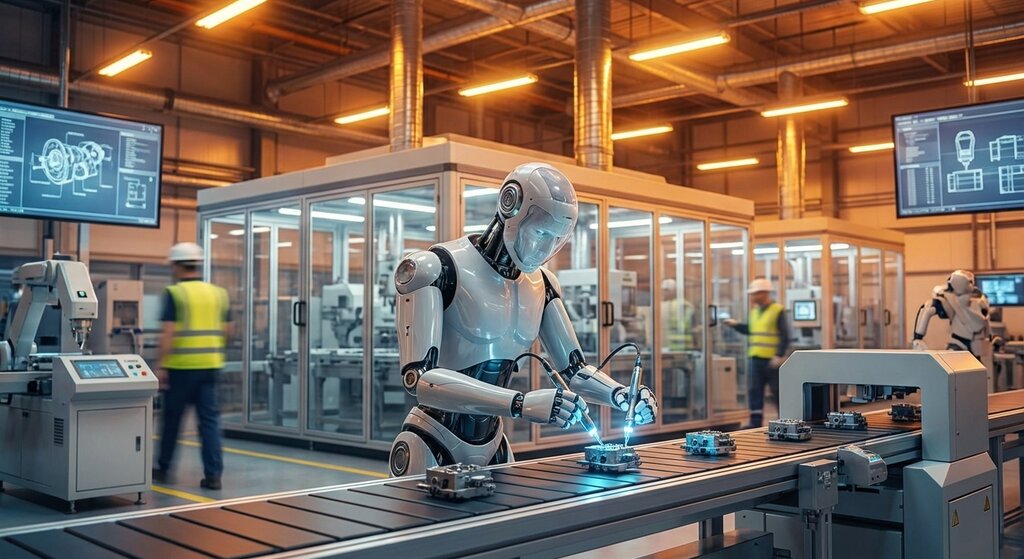
Unitree Robotics released footage this week showing its G1 humanoid operating on an actual production line inside the company's own manufacturing facility. The robot is assembling robot parts. Let that sink in for a moment: robots building robots, in a real factory, doing real work.
The UnifoLM-X1-0 Model
Powering this deployment is Unitree's newly debuted UnifoLM-X1-0 embodied AI model. This appears to be an evolution of the company's broader UnifoLM software suite, which was originally designed to streamline data acquisition and training for physical AI systems.
The strategic brilliance here is the closed loop. By deploying humanoids in its own factory, Unitree creates a perpetual data engine — every task the robot performs generates training data that makes the next generation better. It's the kind of flywheel effect that separates companies positioning for the long game from those chasing demos.
From Performer to Worker
The G1 has been Unitree's flagship platform, with over 5,500 units shipped in 2025 — making it one of the most widely deployed humanoid platforms on the planet. But until now, most of its public appearances involved choreographed performances, promotional stunts, and controlled demonstrations. Dancing at galas. Surviving -47°C in the Altay Mountains for a Winter Olympics marketing push.
Moving to actual factory labor — even in a controlled, in-house setting — is a fundamentally different proposition. It demands sustained precision, repeatability, and reliability that no dance routine can approximate.
The IPO Timeline
This factory deployment isn't happening in a vacuum. Unitree is actively preparing for a mid-2026 IPO, and demonstrating real industrial utility is exactly the kind of narrative shift that transforms a "cool robotics company" into a "serious manufacturing play" in the eyes of public market investors.
The timing tracks with broader market momentum. Apptronik just closed $935 million in total Series A funding. Figure AI is valued at over $40 billion. 1X Technologies continues scaling NEO production. The capital markets have made their bet: humanoid robotics is the next mega-category, and companies that can show real-world deployment — not just demos — will command premium valuations.
What This Means for the Industry
Unitree's factory deployment validates something the entire humanoid ecosystem has been building toward: the transition from controlled demonstrations to genuine commercial utility. When a humanoid robot can work an assembly line building more humanoid robots, the scaling math changes dramatically.
For the operational infrastructure layer — companies like ours focused on deployment, maintenance, and fleet management — this is exactly the kind of milestone that accelerates the timeline. More robots being built faster means more robots that need to be deployed, maintained, serviced, and managed in the field.
China's state-owned enterprises are also getting in on the action, recently launching an embodied intelligence consortium that includes Unitree alongside Huawei and other tech giants. The institutional backing signals this isn't a startup science project — it's becoming national industrial policy.
The Takeaway
We're watching the humanoid robotics industry cross a critical threshold. The question is no longer "can humanoid robots do useful work?" It's "how fast can we build and deploy them?" Unitree just answered that by putting the robots themselves to work on the answer.
The recursive loop is closed. The only question now is how fast it spins.