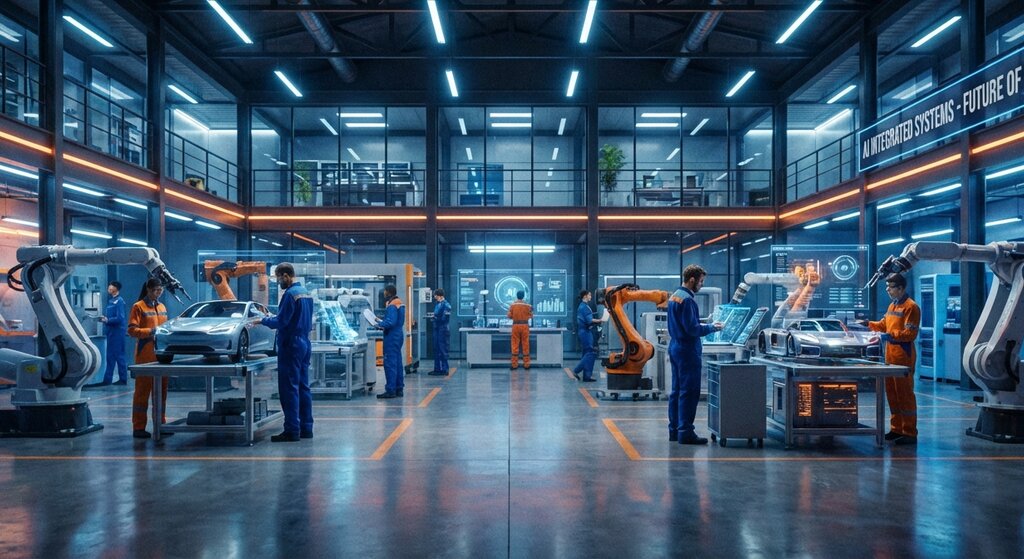
RobCo Raises $100M Series C for Physical AI Manufacturing Robotics
RobCo, the Munich-based robotics company building "Physical AI" for manufacturing, just closed a $100 million Series C round. That's not incremental funding—that's a declaration that autonomous manufacturing robotics has crossed from experimental to industrial scale.
The round was co-led by Lightspeed Venture Partners and Lingotto Innovation (Ferrari's industrial investment arm), with Sequoia Capital, Greenfield Partners, and others joining. The investor mix tells the story: pure-play VCs who build category-defining companies on one side, deep industrial operators with factory floor experience on the other.
What RobCo Actually Does
Founded in 2020, RobCo combines perception, motion planning, and self-learning into a platform that reduces friction between existing manufacturing processes and end-to-end automation. Their pitch: automate the ordinary, so humans focus on the extraordinary.
The company targets manufacturing—arguably the hardest environment for robotics. Unlike warehouse or home settings, factories have legacy equipment, unpredictable workflows, and zero tolerance for downtime. RobCo's approach treats the entire production environment as a learning system rather than programming individual tasks.
The Funding Signal
$100 million at Series C puts RobCo firmly in the industrial robotics major leagues. CEO Roman Hölzl made the company's ambition clear: "We will become the dominant AI robotics company for manufacturing in the U.S. and Europe."
That dominance claim isn't idle. The funding specifically targets US market expansion—RobCo is following the same playbook as other European robotics companies that recognized early that the American labor shortage creates demand velocity unmatched in their home markets.
RRC Perspective: Physical AI Needs Physical Operators
RobCo's raise validates a thesis we see across the industry: AI without operational infrastructure fails on contact with reality. You can have the smartest perception models and the most sophisticated motion planning, but someone still needs to deploy, maintain, repair, and recover these systems.
The "Physical AI" framing RobCo uses is perfect shorthand for what the industry needs—software that understands physical environments. But that physical understanding requires physical support infrastructure. Someone has to be there when sensors drift, when grippers wear, when environments change faster than models retrain.
RobCo's investor syndicate includes industrial operators (Lingotto, The Friedkin Group) precisely because they understand this gap. Manufacturing robots deployed without maintenance networks become expensive factory sculptures. Professional operators, same-day swap, and continuous fleet health monitoring—these aren't luxuries, they're requirements for industrial scale.
The European Invasion
Munich-founded, now targeting US expansion with fresh Silicon Valley capital. RobCo joins a growing list of robotics companies (1X, Kassow, others) recognizing that the American manufacturing landscape offers the best stress test for autonomous systems: aging infrastructure, variable quality of legacy equipment, and—critically—customers desperate enough to try automation because human labor simply isn't available.
The physical AI wave is here. The question isn't whether these systems work—it's whether we have the operational infrastructure to keep them working.