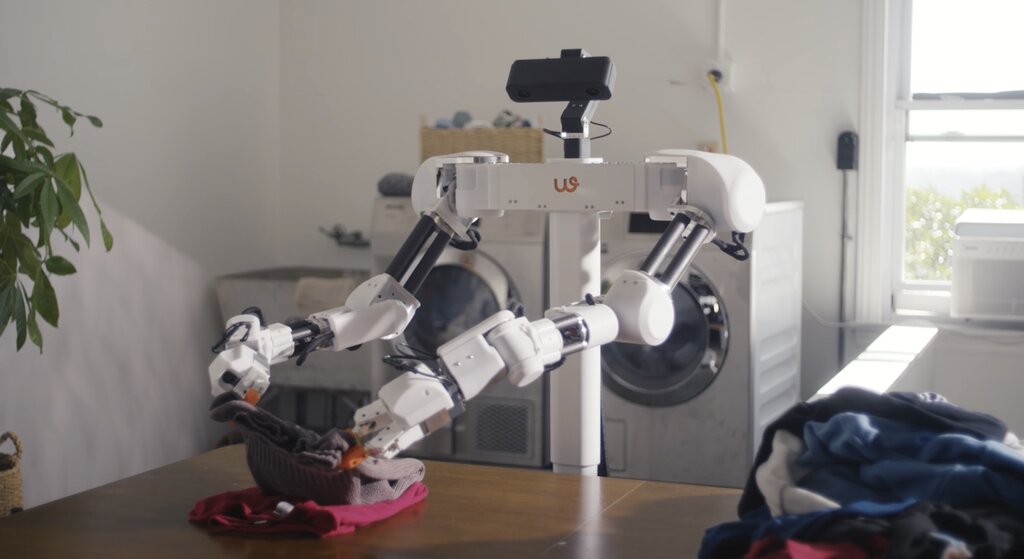
Weave's Isaac 0: Why a Laundry-Folding Robot Might Be the Most Practical Home Bot Yet
The robotics industry has spent the last year obsessing over humanoids. Figure. 1X. Tesla. All chasing the same vision: a general-purpose humanoid robot that can do anything.
Meanwhile, Weave Robotics just quietly launched something different. Something that might actually matter more in the near term.
Meet Isaac 0. A robot that does exactly one thing: fold your laundry. And it's shipping to SF customers right now.
The Single-Task Revolution Nobody's Talking About
There's a tension in robotics that the industry rarely acknowledges. General-purpose humanoids are spectacular demos. They're also spectacularly hard.
Every degree of freedom. Every surface interaction. Every edge case your kitchen, living room, and bathroom throw at a robot — these compound geometrically. The result is that even the most advanced humanoids are still basically expensive prototypes, not reliable home appliances.
Weave took the opposite bet. What if you built a robot that only needed to understand one physical environment (a folding area), one material property (fabric), and one task (folding)?
The result: Isaac ships in 2026. Not "maybe." Not "if we solve general manipulation." This year.
The Laundry Math Nobody Wants to Do
The average American household does 6-8 loads of laundry per week. Folding time: 30-45 minutes per load. That's 3-6 hours of weekly folding, or 150-300 hours per year.
Now multiply by household size. A family of four? You're pushing 500 hours annually on laundry-related tasks.
This is the kind of number that makes $250 deposits and whatever the final hardware costs feel almost trivial. If Isaac saves even 200 hours per year, we're talking productivity economics that actually compute.
Y Combinator, Sensible Deployment, and Real Data
Weave came out of YC's Summer 2024 batch — the same program that launched Coinbase, Dropbox, and Stripe. The playbook is familiar: prove demand with a limited launch, collect real-world data, iterate fast.
The deployment model is clever. Rather than trying to navigate every possible American home immediately, Weave partnered with Tumble — a laundromat network with pickup and delivery already built. Customers schedule through Tumble; their laundry comes back cleaned, dried, and robot-folded.
This is precisely how you actually deploy robotics at scale. Limited environment. Real usage. Actual feedback loops. The robot learns on real laundry from real customers, not synthetic datasets.
The Infrastructure Layer Angle
Here's what matters for Robot Rental Company: Isaac's success validates a thesis we've held from the beginning.
Not every home robot needs to be a generalist. In fact, the most reliable path to widespread adoption might be through specialists that do one thing incredibly well.
We wrote about the open-sourcing of Tiangong 3.0 a few days ago. The humanoid generalist wave is real — and we're positioned for it.
But Isaac represents the other end of the spectrum. Task-specific robots. Narrow intelligence. Deep capability in a constrained domain.
Both approaches matter. Both will coexist. The families who rent our NEO units for Elder Care will absolutely also want laundry solutions. The households who start with Isaac might graduate to humanoids for other tasks.
The Practical Home Robot Is Here
Weave's launch marks a milestone that shouldn't be lost: 2026 is the year the first practical, commercial home robots ship to real customers.
Not tireless humanoids that fold clothes, make beds, and cook dinner. Something more modest. Something that actually works.
Sometimes the future isn't a robot that does everything. Sometimes it's a robot that does one thing really, really well.
Isaac folding laundry isn't a failure of ambition. It's a triumph of focus.
Ready to try a humanoid robot in your home? Join the waitlist for summer 2026 trials with 1X NEO.