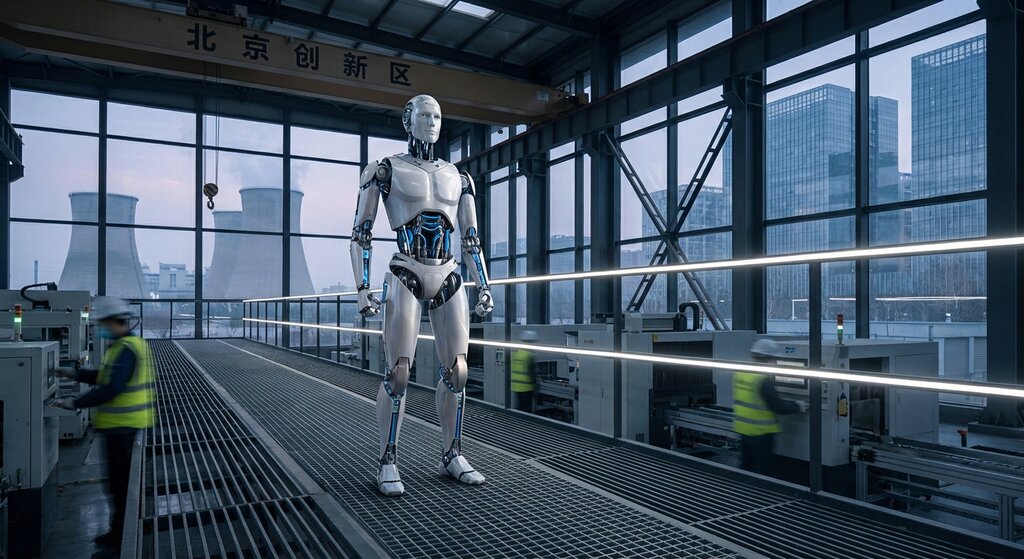
Tiangong 3.0: Why Open-Source Humanoids Make Infrastructure the Real Moat
Tiangong 3.0: Why Open-Source Humanoids Make Infrastructure the Real Moat
February 12, 2026
The Beijing Humanoid Robot Innovation Center just made a move that signals a fundamental shift in the robotics industry. They unveiled Tiangong 3.0—a 43-degree-of-freedom humanoid with parkour-level mobility—and announced they're open-sourcing the hardware design and vision-language models.
This isn't just another robot demo. This is the hardware barrier collapsing in real time.
What Tiangong 3.0 Actually Does
The specs are serious:
- 43 degrees of freedom — more articulation than most industrial arms
- 1-meter obstacle navigation — parkour-level mobility
- ROS2 and MQTT support — direct factory workflow integration
- Open body design — anyone can manufacture compatible hardware
- Open vision-language models — embodied intelligence for real-world adaptation
The "X-Humanoid" platform isn't just showing off capabilities. It's removing friction for anyone who wants to build, modify, or deploy humanoid robots.
The Pattern Nobody's Talking About
Here's what's hiding in plain sight: the cost of building humanoid robots is dropping faster than the cost of deploying them.
When Tiangong 3.0's design becomes freely available, dozens of manufacturers will produce variations. Some will focus on factory floors. Others on warehouses. Some on elder care. The hardware will fragment across use cases and price points.
And that's exactly when the bottleneck shifts.
Why Infrastructure Becomes Everything
History rhymes. The PC revolution didn't crown Compaq or Gateway as the long-term winners. It crowned Microsoft and Intel—the infrastructure layer. The smartphone wave didn't make HTC or Nokia immortal. It made iOS and Android the platforms that mattered.
Tiangong 3.0's open-source move accelerates the same pattern in humanoids:
More manufacturers → More fragmentation → More coordination overhead → More need for standardized deployment infrastructure
Every Tiangong derivative that rolls off a production line needs:
- Fleet management and coordination
- Charging infrastructure and battery logistics
- Maintenance, repair, and spare parts networks
- Deployment workflows and training protocols
- Integration with existing factory and warehouse systems
That's the infrastructure layer. That's the moat.
The Deployment Gap Is Real
Manufacturers like Tiangong's backers, 1X, Figure, Apptronik, and Boston Dynamics are racing to capability. They're solving the hard technical problems: balance, manipulation, embodied intelligence.
But who's solving the soft operational problems?
Who delivers these robots to factory floors? Who maintains uptime when joints fail at 2 AM? Who trains local technicians across hundreds of facilities? Who manages charging cycles, sanitization protocols, and safety certifications?
The answer, right now, is: nobody at scale.
Why RRC Exists in This Moment
Robot Rental Company isn't betting on a single manufacturer winning the humanoid race. We're betting that every manufacturer will need help getting their robots into the field—and keeping them there.
Tiangong 3.0's open-source announcement validates this. When the hardware becomes commodity, the operational expertise becomes the differentiator.
We've built:
- Fleet management infrastructure for multi-manufacturer coordination
- Broker approval workflows that let facilities spin up robot deployments without procurement bottlenecks
- Real-time telemetry and monitoring for operational visibility across heterogeneous fleets
- Service and recovery protocols for maintaining uptime no matter whose robot needs attention
When Tiangong derivatives, 1X NEOs, Apptronik Apollos, and Figure 01s all need to coexist in the same logistics facility, someone has to make that work operationally.
That's us.
The Bottom Line
Tiangong 3.0 isn't just a technical achievement. It's a signal that the humanoid industry is entering its infrastructure phase.
The robots are getting good, fast. The hardware is becoming accessible. The open-source movement is accelerating both.
But deployment? That's still hard. That's still underserved. That's still the opportunity.
At Robot Rental Company, we're building the Layer 2 that makes Layer 1—the incredible robots coming out of Beijing, Austin, Oslo, and everywhere else—actually usable at scale.
The open-source robot movement doesn't threaten our thesis.
It IS our thesis.
Robot Rental Company is building the operational infrastructure for humanoid robot deployment. Home trials begin July 2026. Commercial fleet operations launching soon.
Want to experience the future? Join our waitlist for early access to NEO, Apollo, and the entire humanoid fleet.