Boston Dynamics Atlas Just Did Something That Changes Everything
Boston Dynamics Atlas Just Did Something That Changes Everything
February 9, 2026
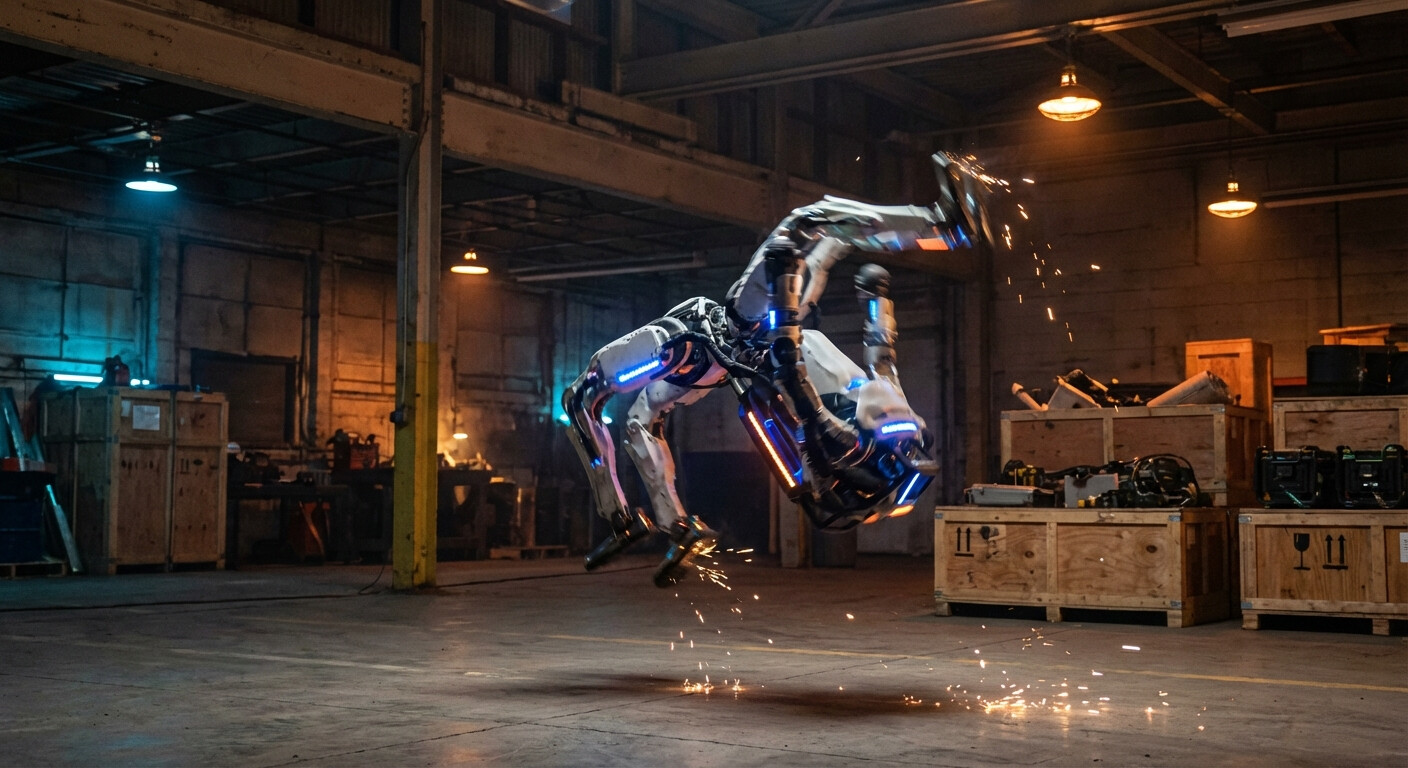
Boston Dynamics released a video today that looks like a stunt. Atlas, their electric humanoid robot, performs a backflip while emerging from a cartwheel.
But this isn't a demo trick. It's a signal.
From Lab to Reality
For years, critics had a comfortable dismissal: "Humanoid robots work in labs, not the real world."
The argument made sense. Lab floors are flat. Lab lighting is perfect. Lab schedules don't include surprises. The controlled environment lets engineers iterate, but it doesn't prove the robot can handle reality.
Today's video moves the goalposts. Atlas isn't just walking across a stage. It's executing dynamic athletic motion—pushing balance to the edge, recovering from instability, landing under control. TRT World's analysis puts it simply: "Atlas is built for real-world use, handling complex movement and harsh environments."
Why This Matters for the Timeline
The technical evolution is the story. Boston Dynamics transitioned Atlas from hydraulic to fully electric. That meant building custom high-torque actuators from scratch—no off-the-shelf components for this level of performance.
The result: a robot that can now iterate rapidly. What took weeks to adjust in hydraulic systems can now happen in days. That acceleration compounds.
Here's where it gets interesting for the market:
-
Tesla is pivoting Model S/X production to free factory space for Optimus. $20B+ capex directed toward humanoid production with factory deployment targeted for 2025.
-
ARK Invest sees humanoid revenue potential at $10-50B by 2028.
-
Morgan Stanley pegs the humanoid market at $100B+ by 2030.
-
EQT committed up to $1B for 10,000 units from 1X Technologies—institutional capital making long bets.
Every manufacturer is racing to capability. And Atlas just showed that the capability curve is steeper than expected.
What This Means for Deployment
We're watching the hardware market accelerate faster than the infrastructure to support it.
That's where Robot Rental Company fits. We're building the Layer 2—the rental networks, repair shops, delivery logistics, charging infrastructure, fleet management, and training programs that none of the manufacturers are prioritizing.
Manufacturers build the robots. We put them to work.
Home trials start July 2026. Limited availability. If you've been waiting to see what these machines can actually do, the timeline just moved up.